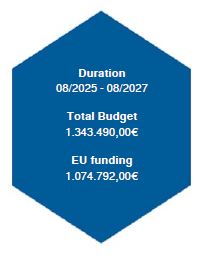
The FireFly project primary goal is the prevention and efficiently management of forest fires in cross-border regions through a cooperation protocol for rapid response, effective surveillance and intervention strategies minimizing fire impact on ecosystems, wildlife, property and human lives. Specific objectives include Prevention and Protection, Capacity Improvement, Innovation, and Public Awareness. Forest fires know no national borders, rapidly destroy the natural and residential environment and requiring coordinated response. Local efforts lack scale and data, while cross-border collaboration enables resource pooling for strategic impact.
This project is significant since cross border areas host vital forests, NATURA areas, wetlands and national parks critical for environmental sustainability and tourism. Early fire detection is essential for climate change mitigation, as forests serve as carbonsinks, when burned, they release CO2, increasing the risk of desertification and flooding in affected areas.
The types of partners, their experience in EU project implementation and their geographical coverage (national, regional) ensure accurate and qualitative deliverables and wide dissemination of results. Partnership includes two public bodies: Ministry, PROTECTION AND RESCUE DIRECTORATE, with key role in natural disaster management, with offices and emergency intervention teams in eligible area and REGION OF CENTRAL MACEDONIA that his Independent Civil Protection Directorate implements National strategies. Two partners governed by public law: LIFELONG LEARNING CENTER ΟF REGION ΟF CENTRAL MACEDONIA SA, specializing in HR management, EU program submission and implementation, accredited by Ministry of Education to organizing trainings and workshops, the CENTER FOR DEVELOPMENT OF PELAGONIJA PLANNING REGION, coordinates 9 municipalities in submission, implementation and management of EU programs…And the nonprofit SERRES AIRCLUB, member of Sports General Secretariat, has a voluntary civil protection team and 20 trained pilot in ultralight aircrafts.
Innovations include advanced equipment and joint pilot actions:
- Gyroplane: Advanced aircraft, that operates in extreme conditions, can be used as air-Ambulance and need 5-10 meters to land, 100 meters to take off
- Artificial Intelligence Fire detection and warning system: smart camera detectors with AI algorithms and machine learning capability, for early fire detection and minimal human intervention.
- Specialized Firefighting SUV: vehicle reaching hard-to-reach terrains, equipped with versatile firefighting tools.
- Joint Pilot actions: Aerial Surveillance and Coordination forest fire simulation, air-ground cooperation exercise and International Air Rally competition, target detection with speed.
- Symposium: with EU, administrative and civil protection representatives
Additional project activities encompass training and workshops (GIS, disaster management, First Aid), studies, social/media campaigns, study visit and public awareness events. The project strengthens capacity by advancing skills on cutting-edge technologies, sharing expertise and analyzing research and best practices to improve fire management practices.